
Welcome! Unlock Your First Offer Here
Welcome! Unlock Your First Offer Here
Welcome Partners! Talk to us, Unlocking A Booming Market!
Welcome Partners! Talk to us, Exploring a High-Potential Market!
Leave Your Questions, Expert Support At Your Service!
Redefine a Comfortable Sofa


Compressed Sofa Compliance for the US and EU: What Importers Should Check
A sofa that clears the factory gate can still face problems before it reaches the market. Compliance issues can lead to delays, additional testing, product changes, returns, or other unexpected costs.
Compressed sofas involve foam, fabric, zippers, supporting components, packaging, and labels. Different markets apply different product-safety requirements.
Compliance should be considered before mass production starts. Laboratory testing is only one part of the process. A third-party laboratory verifies the sample submitted for testing, while the manufacturer controls the materials, workmanship, production, compression, packaging, and documentation around that sample.
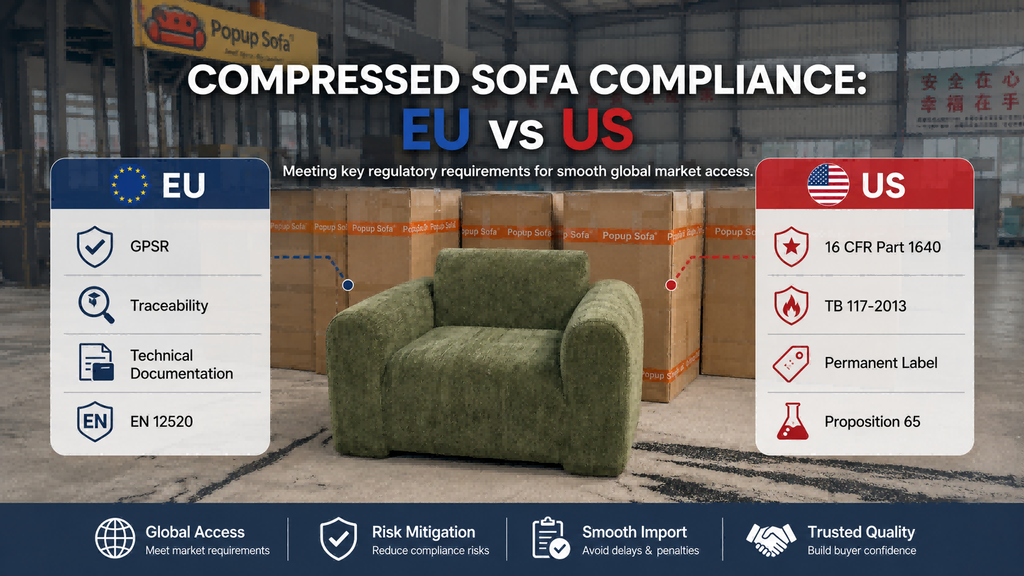
The General Product Safety Regulation, or GPSR, has applied since 13 December 2024 and replaced the older General Product Safety Directive. GPSR is a core product-safety framework for consumer products placed on the EU market.
A product covered by GPSR cannot be placed on the EU market unless an economic operator established in the EU is responsible for it. For products imported from outside the EU, the importer may perform this role depending on the supply structure.
Responsible economic operator. The responsible party should be identified before the product enters the EU market.
Traceability. The product and its packaging should contain sufficient information to identify the manufacturer and the product.
Technical documentation. Manufacturers should prepare documentation that identifies the product and supports its safety assessment, including relevant risk information and measures used to control identified risks.
Factory production records can form part of this traceability process. During final packing, product models, specifications, quantities, and customer information are checked before labels are applied to cartons.
EN 12520:2024 is a relevant European standard for assessing the safety, strength, durability, and stability of domestic seating. It is not a certificate that customs automatically requires at the border. Test evidence based on the standard can instead show how a seating product has been assessed against defined performance requirements.
Importers should check whether the test evidence covers the ordered model or an applicable product range.
Laboratory testing and production control serve different purposes. Laboratory testing evaluates the performance of the tested product. Production control helps keep the manufactured product consistent with the approved design.
16 CFR Part 1640 is the federal smolder-resistance standard for upholstered furniture in the United States. It incorporates the relevant smolder-resistance requirements of California Technical Bulletin 117-2013.
Depending on the sofa construction, relevant components can include cover fabrics, resilient filling, barrier materials, and decking materials. A permanent compliance label is also required for upholstered furniture covered by the federal rule. Importers should confirm the applicable labeling requirements before shipment.
For compressed sofa models that use polyurethane foam as a primary filling material, foam may be submitted for resilient filling material testing. The polyurethane foam used in production follows a fixed internal production and performance standard developed through years of production experience and repeated testing. The exact formulation and internal parameters remain proprietary. When raw materials or suppliers change, the manufacturer should verify the new material before it enters mass production. A practical approach is to evaluate trial samples first, then move to a small production batch before full-scale production. Materials that do not meet the required performance should not be introduced into bulk production.
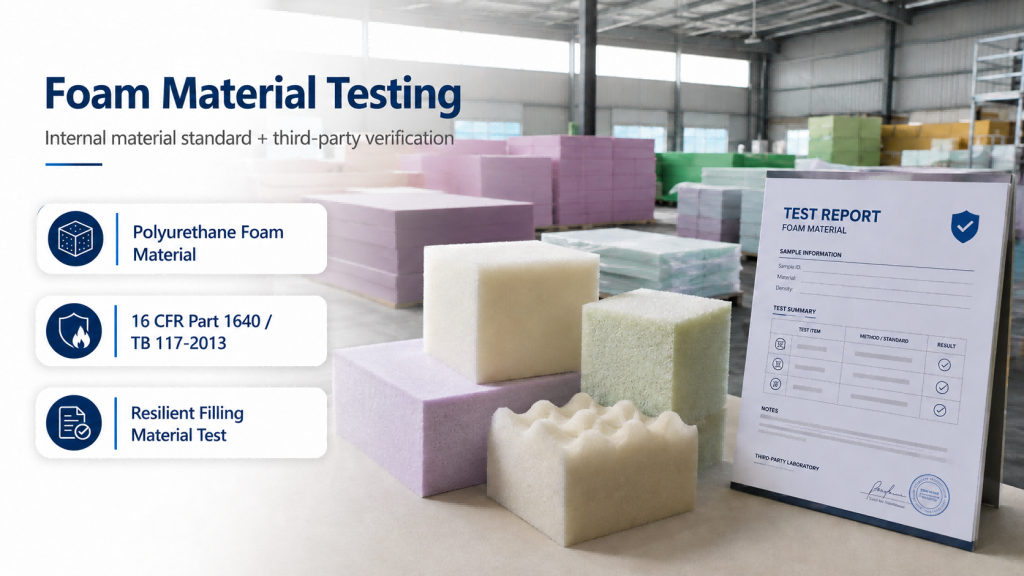
Separate material testing can evaluate rebound, permanent deformation after compression, tensile strength, formaldehyde emission, ash content, and apparent density. One independently tested foam sample was evaluated under recognized test methods. These results describe that tested sample and should not be treated as universal specifications for every foam grade.
California Proposition 65 is different from the federal smolder-resistance rule. It requires businesses to consider consumer exposure to listed chemicals and provide warnings when applicable. It is a California requirement rather than a nationwide federal product standard.
Depending on the product, materials, and customer requirements, laboratory testing may form part of a Proposition 65 evaluation. Relevant materials can include foam, fabric, coatings, adhesives, and other components. Testing may look at substances such as lead, cadmium, or selected phthalates.
Material identification matters because an earlier test report should not automatically be treated as applicable when the material or product construction has changed. Manufacturers should maintain enough batch information to trace key materials used in production. For foam, this can include production time, material-mixing records, and batch identification. Fabric should also be linked to the relevant production batch so that a specific order can be investigated if a quality issue appears later.
For importers, the question is not only whether a supplier has a test report. It is also whether that report applies to the material and product configuration used in the actual order.
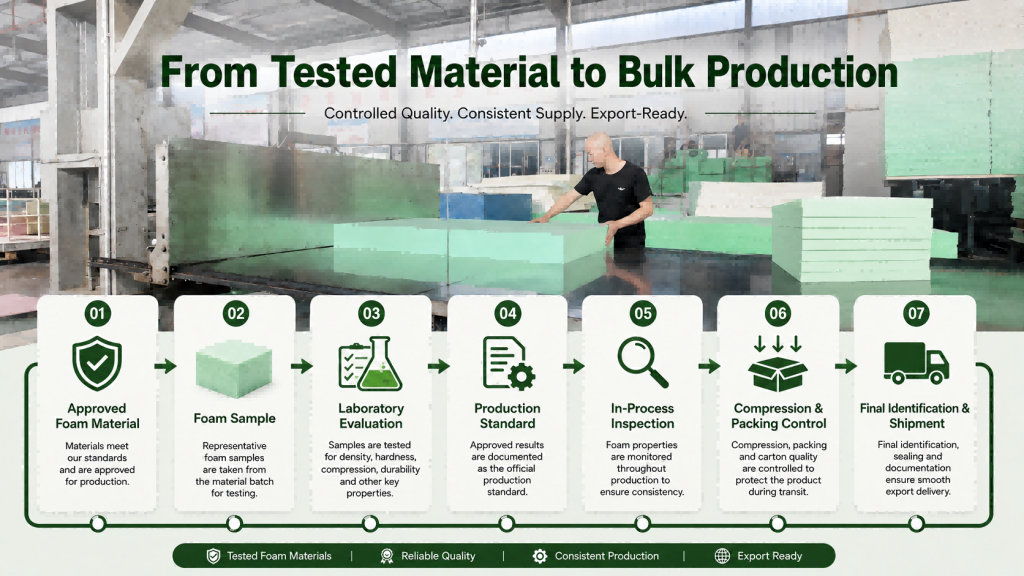
A useful compliance process follows a controlled sequence:
Approved material → Product sample → Laboratory evaluation → Production standard → In-process inspection → Compression and packing control → Final identification and shipment
A good compliance system should not depend only on one sample sent to a laboratory. Third-party test samples should represent the materials and product configuration used in normal production as closely as possible. One practical way to reduce the gap between laboratory evidence and bulk production is to select test materials or products directly from regular production rather than prepare separate samples only for testing.
Importers should confirm several points directly with a manufacturer for each project:
Before starting production, importers should confirm the evidence that applies to their destination market.
Importers should also confirm whether the documents apply to the actual model, material, and configuration being ordered.
Compliance is not created by a laboratory report alone. The laboratory verifies the sample and test scope. The manufacturer controls what happens before and after that test.
The most reliable approach is to connect test evidence with production control. When the tested material, approved product specification, manufacturing process, and actual bulk order remain aligned, compliance becomes part of manufacturing management rather than a document collected only before shipment.


