
Welcome! Unlock Your First Offer Here
Welcome! Unlock Your First Offer Here
Welcome Partners! Talk to us, Unlocking A Booming Market!
Welcome Partners! Talk to us, Exploring a High-Potential Market!
Leave Your Questions, Expert Support At Your Service!
Redefine a Comfortable Sofa


Every importer has encountered this problem: why do shipping quotes for sofas in the same container differ by thousands of dollars? Why do some products appear cheaper at the factory, yet end up costing significantly more upon arrival?
The answer lies in the structure of transportation costs.
In practice, sofa shipping costs are primarily driven by volume (CBM), packaging efficiency, transportation method, and last-mile delivery. Among these, volume and packaging design often account for more than 60% of total logistics cost differences, making them the most critical factors for importers to control.
This is not merely a pricing issue, but a structural one. This article analyzes the key cost drivers behind sofa logistics from these dimensions, helping importers understand not only how much they are paying, but also why those costs occur.
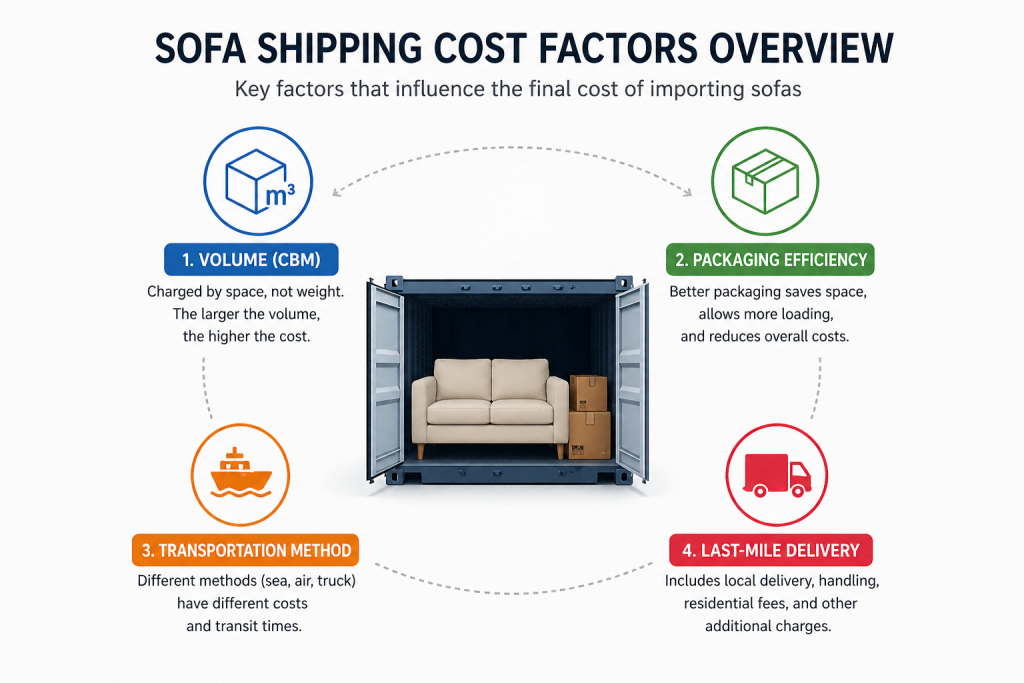
Volume is the most critical factor because sofa freight is typically charged based on cubic meters (CBM), not actual weight.
For sea freight, the standard pricing model is based on:
1 CBM = 1 chargeable unit (W/M rule)
In air freight, volumetric weight is calculated using:
Volume Weight (kg) = Length × Width × Height (cm) ÷ 6000
(In some cases, ÷5000 may be used depending on the carrier or region, but CBM remains the standard for sea freight.)
Due to internal empty space (frames, cushions), sofas are classic “volume-heavy cargo”, meaning:
This is where most cost misunderstandings begin. Importers often compare factory prices, but logistics costs are determined by space efficiency rather than product value.

| Product Type | Typical Volume | Shipping Cost Share |
|---|---|---|
| Traditional Sofa | 1.2–1.8 m³ | High (60–70% of CIF) |
| Flat-Pack Sofa (RTA) | 0.6–1.0 m³ | Medium (40–50%) |
| Compressed Sofa | 0.15–0.25 m³ | Low (20–30%) |
A 40HQ container holds ~67.6 m³, but actual usage is only 80–85% due to:
Why this matters: even a 5–10% improvement in container utilization directly reduces per-unit shipping cost.
Key Insight: Standardized packaging can increase utilization to 90–95%, creating immediate and measurable cost savings.
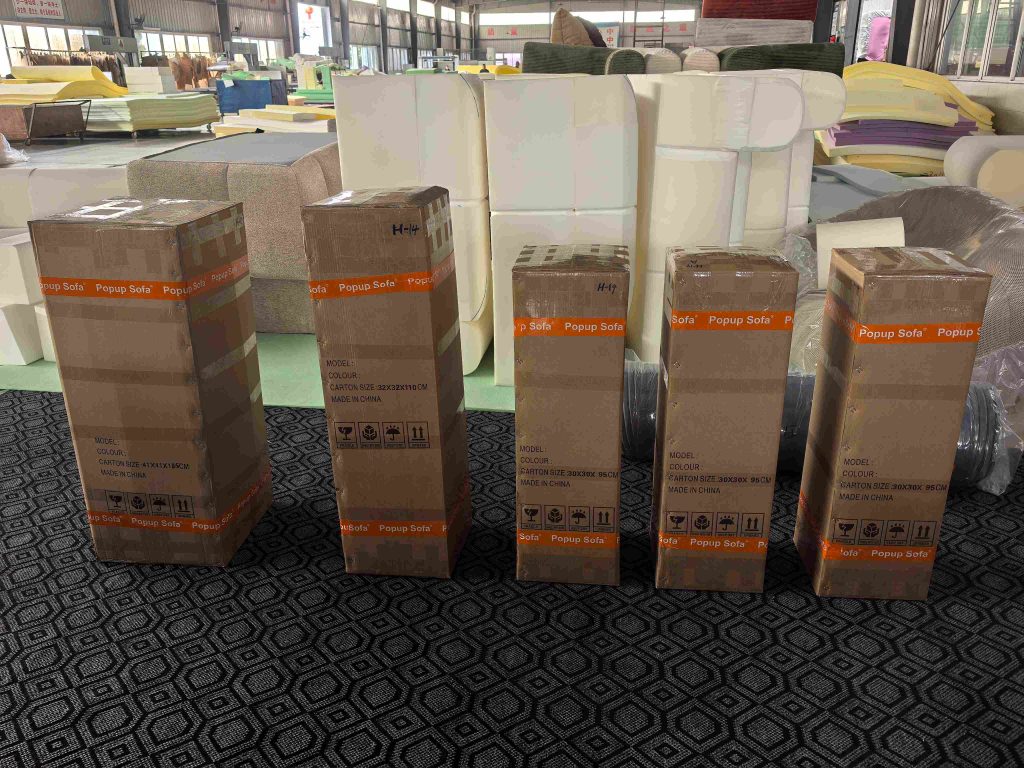
If volume is the cost driver, packaging is the control mechanism.
Packaging determines how efficiently space is used, making it one of the highest-impact variables in sofa logistics.
| Packaging Type | Efficiency | Protection | Handling Difficulty | Typical Use |
|---|---|---|---|---|
| Assembled | Low | Medium | High | Traditional sofas |
| Flat-Pack (RTA) | Medium | High | Medium | IKEA-style |
| Compression | Very High | High | Low | Compressed sofas |
Well-designed cartons significantly improve logistics performance:
In practice, poor carton design leads directly to wasted space and higher damage rates, even when the product itself is well manufactured.
Key Insight: Reducing packaging volume by 50–70% often delivers greater cost savings than negotiating freight rates.
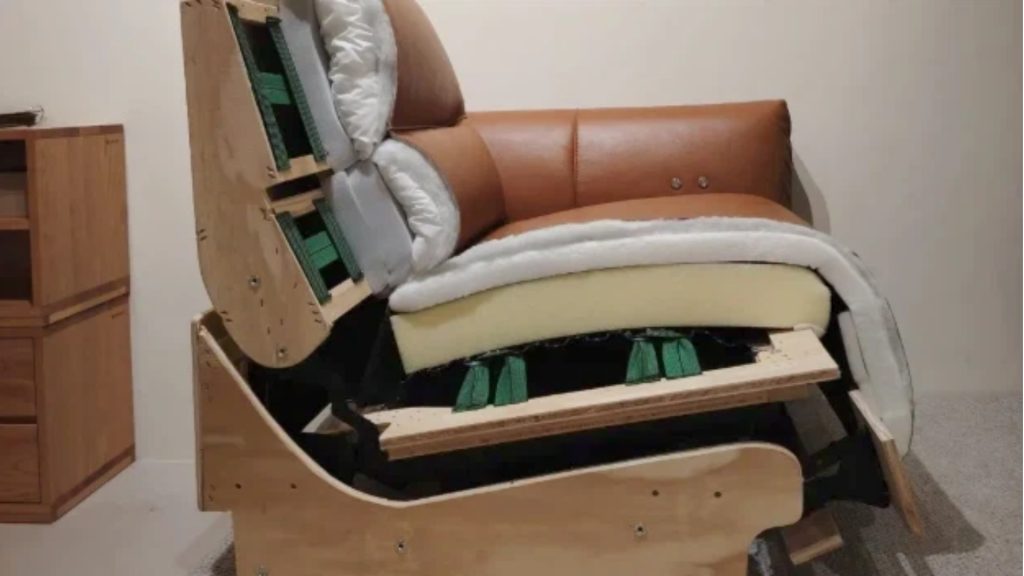
While volume dominates sea freight costs, weight becomes critical in specific scenarios.
| Material | Density | Shipping Impact |
|---|---|---|
| Low-density foam | 20–25 kg/m³ | Minimal impact |
| High-density foam | 35–40 kg/m³ | Moderate |
| Solid wood | 500–700 kg/m³ | Significant increase |
| Metal components | ~7800 kg/m³ | High density impact |
This means that optimizing for volume alone is not sufficient—material selection must also align with the chosen transportation method.
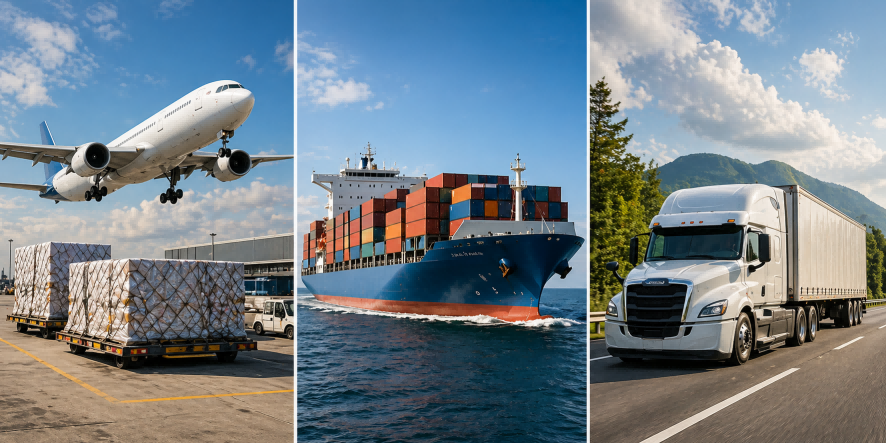
Shipping method selection directly determines both cost structure and delivery speed.
This is where many importers lose margin—not because of product choice, but because of incorrect logistics decisions.
| Method | Transit Time | Cost Level | Best Use Case |
|---|---|---|---|
| FCL Sea Freight | 25–35 days | Low | Bulk shipments |
| LCL Sea Freight | 30–45 days | Medium–High | Small batches |
| Air Freight | 3–7 days | Very High | Urgent orders |
| Rail (EU) | 18–22 days | Medium | Europe-bound goods |
| Method | Unit Cost | Scenario |
|---|---|---|
| FCL | $15–25 | Bulk orders |
| LCL | $30–50 | Testing orders |
| Air | $150–250 | Urgent restocking |
Choosing the wrong transportation method can double total logistics cost, even when product pricing remains unchanged.
Last-mile delivery is one of the most underestimated cost drivers in sofa logistics.
It is also where many importers lose control over pricing.
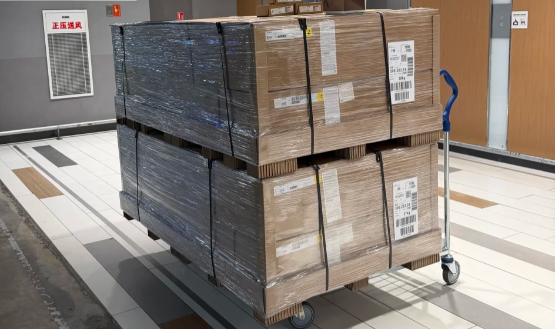
| Stage | Cost Range |
|---|---|
| Port handling | $200–$500/container |
| Inland trucking | $500–$1,500 |
| Oversized item fee | $75–$150/item |
| Upstairs delivery | $50–$150/item |
Typical thresholds include:
Key Insight: Products that avoid oversized classification can significantly reduce last-mile delivery costs and improve overall margin control.
Many importers calculate freight costs accurately but overlook secondary costs that accumulate across the supply chain.
| Product Type | Monthly Cost |
|---|---|
| Traditional | $4–6 |
| Flat-Pack | $2–3 |
| Compressed | $1–2 |
In practice, these hidden costs can accumulate quickly and are often not reflected in initial freight quotations.
| Strategy | Impact |
|---|---|
| Reduce volume | 50–70% freight savings |
| Standardize cartons | +10–15% efficiency |
| Improve strength | Better stacking |
| Business Model | Recommended Product |
|---|---|
| E-commerce | Compressed sofas |
| Retail stores | Mixed selection |
| B2B projects | Compressed sofas |
Transportation cost is the largest variable in sofa importing—and also the most controllable.
For most importers, the real competition is no longer product price alone, but logistics efficiency. Those who optimize volume, packaging, and delivery structures are not just reducing costs—they are building a sustainable competitive advantage in increasingly competitive global markets.


