
Welcome! Unlock Your First Offer Here
Welcome! Unlock Your First Offer Here
Welcome Partners! Talk to us, Unlocking A Booming Market!
Welcome Partners! Talk to us, Exploring a High-Potential Market!
Leave Your Questions, Expert Support At Your Service!
Redefine a Comfortable Sofa


Compressed Sofa OEM/ODM: What Importers Should Know Before Starting a Project
A compressed sofa OEM/ODM project is not the same as developing a conventional sofa and adding vacuum packaging at the end.
The product has to satisfy two conditions at once: it must work as a sofa after unpacking, and it must survive compression, storage, transportation, and recovery before the customer ever uses it. Design, foam, structure, fabric, packaging, and testing therefore cannot be treated as separate decisions.
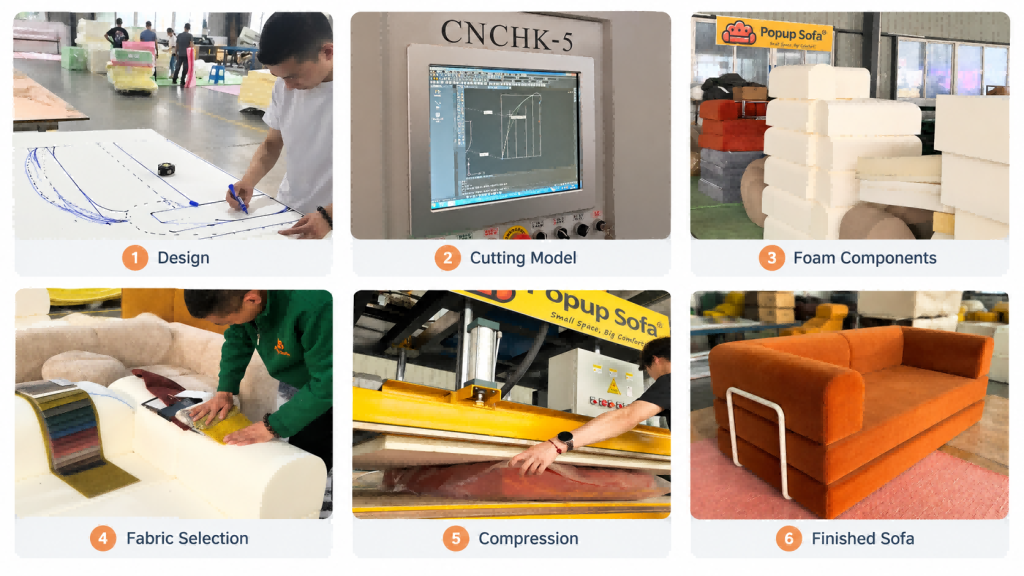
For importers, the main risk is starting development with only an appearance reference and a target price. Based on Popup Sofa’s experience with compressed sofa projects, several issues need to be considered before bulk production begins, including compression feasibility, package targets, foam performance, fabric behavior, structural details, compression testing, and final configuration approval. The following sections explain these issues in the order they are most useful to review during project development.
The first question is not whether the sofa looks good. It is whether the structure can tolerate vacuum compression and still recover correctly.
Some designs are easier to compress because the foam body is more continuous and the structure is simpler. Others create uneven pressure around joints, thick sections, or rigid components.
There is no reliable visual rule that decides whether a sofa can be compressed. A design that looks simple may still develop problems at joints or high-pressure areas, which is why new structures need to be verified through an actual compression test before the design is finalized.
For a conventional sofa, packaging is discussed after design is finished. For a compressed sofa, it needs to be considered much earlier.
The target compressed size affects the foam arrangement, product proportions, folding method, carton size, and loading efficiency. A design may be technically compressible but still fail the commercial target if the package remains too large.

In real B2B inquiries, importers often ask for expanded dimensions, compressed carton dimensions, carton weight, and shipping options before discussing the final order. These details affect both logistics cost and whether the product fits the buyer’s sales model.
The goal is not simply to make the package smaller. It is to balance compression ratio, product recovery, packaging protection, and logistics cost.
Foam in a compressed sofa has two jobs. It affects comfort during use, and it determines how the product behaves after long-term compression.
A buyer usually describes the target in general terms, such as soft, medium, or firm. The manufacturer then has to translate that preference into a foam configuration that can survive compression, because a foam that feels right before packing is not automatically suitable for a vacuum-packed sofa.
The exact configuration depends on the sofa model and project requirements. An in-house foam line can provide more flexibility when these requirements need to be adjusted during development.
For importers, “soft” or “firm” should be treated as a development direction rather than a complete foam specification. The final judgment should be made on the physical sample after both sitting feel and compression recovery have been checked.
Fabric choice also affects compressed-sofa development.
During vacuum packing, the upholstery is folded, pressed, and held under pressure. Depending on the fabric and structure, this can create temporary marks, wrinkles, or uneven tension after unpacking.
Some buyers also ask whether customer-supplied or custom-sourced fabrics can withstand compression. In these cases, fabric selection becomes part of the compression feasibility review, not only a design decision.
The useful question is not whether the fabric looks good before packing, but whether visible pressure marks, wrinkles, surface movement, and seam tension return to the condition agreed for the approved sample after the planned compression and recovery cycle.
Compressed sofas are sensitive to connection points, so these must be decided during design, not left to production.
Larger continuous foam sections reduce unnecessary joints. When sections must be joined, the joint position, bonding direction, and contact area all affect how the structure behaves after compression.

These details should be reviewed during development:
The importer does not need to specify the bonding method. The manufacturer does. What the importer should confirm is whether the joined areas still return to the intended shape after the complete compression and recovery test.
A compressed sofa sample should not be approved only because the appearance, dimensions, and sitting feel look correct. It also has to go through the same compression process planned for production.
A useful development sequence is:
Design review → Sample development → Compression test → Recovery check → Revision if needed → Final sample approval

The compression test confirms whether the product can be packed as planned and whether the structure stays stable after release. For new models, this stage also confirms the final package size.
Real OEM inquiries often combine product specifications, materials, sample approval, branding, packaging, and production timing in one project. The approved sample should therefore become a complete production reference, not only a visual reference.
A change to foam, fabric, structure, or packing can affect performance and recovery. Before bulk production, the key approved items should be fixed and shared between buyer and manufacturer:
| Item | What Should Be Confirmed |
|---|---|
| Product dimensions | Final approved size and configuration |
| Foam | Approved specification and sitting direction |
| Fabric | Material, color, and surface reference |
| Structure | Final joints, support details, and construction |
| Compression method | Folding or rolling method used for the approved sample |
| Package | Compressed size, carton, and protection method |
| Branding | Labels, logo, packaging, and accessories where required |
The purpose is not more paperwork. It is to make sure the approved sample and the bulk production refer to the same product.
A compressed sofa OEM/ODM project should not begin with appearance alone. The product has to be developed around both normal use and the conditions created by vacuum compression.
For importers, the most important work happens before bulk production starts. When the design is suitable for compression, the package target is set early, foam and fabric are evaluated under compressed conditions, and the final sample becomes a clear production reference, OEM/ODM becomes a controlled process rather than a customization request.


